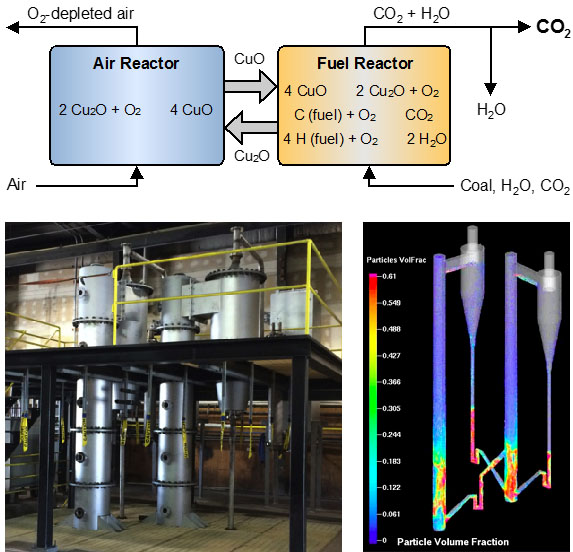
The University of Utah will team with Amaron Energy to advance the development of Chemical Looping Combustion with Oxygen Uncoupling (CLOU) to pilot scale through the operation and thorough evaluation of performance in an existing pilot-scale, dual fluidized bed chemical looping reactor. Chemical looping combustion (CLC) is recognized as one of the most promising carbon dioxide (CO2) capture-ready technologies for producing energy from coal. The University of Utah has been researching CLC since 2007, focusing on the CLOU variant that involves integrated oxygen production and CO2 separation. Specific objectives include (1) performing CLOU processing of U.S. coals in a pilot-scale, dual bed chemical looping system over a range of conditions, with particular focus on carbon conversion and CO2 capture; (2) scaling up production of low-cost copper-based CLOU oxygen carriers; (3) designing a robust carbon stripper to minimize carbon loss to the air reactor in a dual-bed CLOU system; and (4) developing modeling and simulation tools for improving knowledge of the CLOU process, troubleshooting, optimization, and scale-up.
Principal Investigator
Kevin Whitty
kevin.whitty@utah.edu
Project Benefits
The University of Utah will perform pilot-scale testing under this program that will culminate in performance testing that will validate CLOU technology. The program will address critical technology gaps and improve overall system performance by systematically identifying and quantifiably decreasing unit operation energy requirements. This will result in reduced technical risk for chemical looping and development of knowledge and tools to support scale-up of chemical looping combustion technologies. Chemical looping combustion has been identified as having the lowest impact on cost-of-electricity of any CO2 capture-ready power generation technology. In addition, CLOU creates options for efficient processing of solid fuels such as coal. This project represents the first known effort to move beyond the laboratory and test CLOU under industrially relevant conditions.
Website
The University of Utah
http://www.icse.utah.edu/