Business

Business
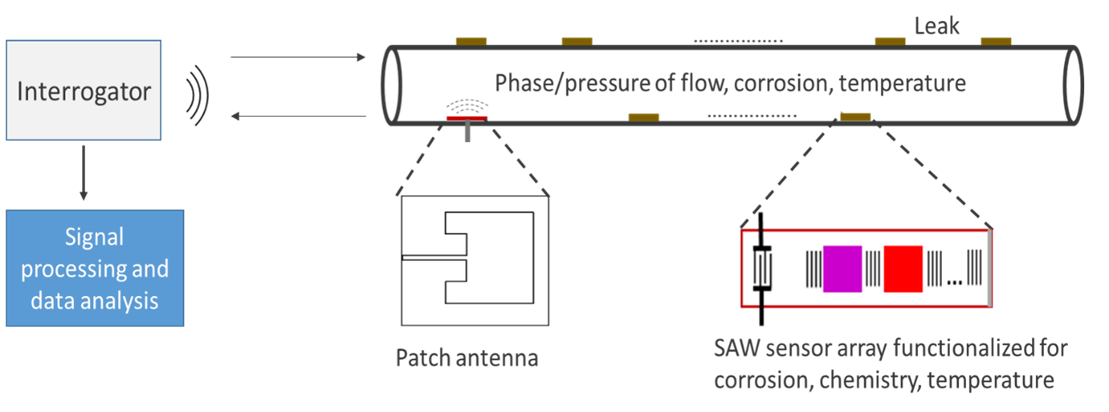
The invention is a system and method for monitoring the interior of metallic tubular structures like pipelines, well-bores, and boiler-tubes using an integrated wireless system. The technology uses a combination of the pipe or tubular structure as a wave guide, integrated radio frequency (RF) patch antennas, integrated passive surface acoustic wave (SAW) sensors, and data analytic methodologies. The technology is available for licensing from the U.S. Department of Energy’s National Energy Technology Laboratory.
Challenge
Safety and longevity are major concerns in fossil fuel industries and other technologies that use long metallic tubular structures like gas pipelines, well-bores, and boilers. Real time monitoring of the tubular structures for multiple variables within them, including but not limited to corrosion, leaks, and mass flow, is crucial to ensure safety and cost-effective maintenance in timely manner. Conventional techniques for investigating the state-of-health and operational conditions of tubular structures use non-destructive acoustic-based techniques, which are limited by the ability to interpret the data because, as an indirect measurement, requires models to be made of the infrastructure under investigation.
NETL researchers have developed a way to use metallic tubular structures as waveguides for RF/microwave electromagnetic radiation over relatively long distances. The NETL technology uses a patch antenna in the integrated system for RF launching and receiving and to power the passive sensors at the interior. The amplitude of the RFs propagated into the pipes, without needing wireless devices, can also be monitored in transmitted or backscattered configuration and correlated with the interior structure changes. The technology also uses passive wireless SAW sensors at the interior of the pipelines to monitor variety of physical parameters, corrosion, as well as chemical species at localized levels. They are passive micro transponder devices that offer real-time monitoring and are stable over a range of environmental conditions. The RFs propagated into the pipes excite SAWs on a piezoelectric substrate. A change in physical environment or chemistry phase induces a change in the SAW velocity and amplitude, which can be measured in terms of frequency/phase or attenuation and related to the original cause. For pipeline applications, an array of SAW sensors can be developed in a single chip and operated using single RF excitation for monitoring. The obtained data, with or without passive wireless sensors, can be integrated within an appropriate data analytical modeling tool or system to allow for real-time monitoring and identification of failures or incidents before they occur.
Advantages
The present invention allows for application of advanced RF and microwave interrogation methodologies to metallic tubular structures such as boiler-tubes, pipes, and well-bores for enabling unprecedented capabilities for asset health monitoring. Advantages include:
There is potential for the technology to be used for a large number of applications that involve metallic tubular structures. Specific fossil energy related applications include:
The invention can be expanded for use on other applications including:
For more information contact us: