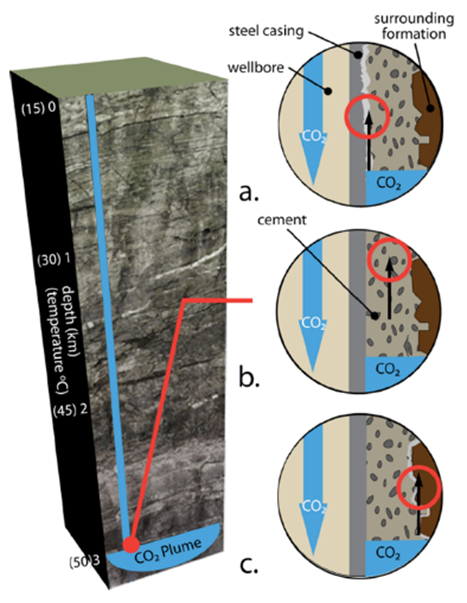
The project will systematically evaluate the potential to deploy targeted carbonation reactions to the leading edge of leaking CO2 as a strategy for mitigating leakage from deep CO2 injection sites. This project focuses on the development of stimuli-responsive coated mineral silicates that can be used in the targeted treatment and remediation of leaking CO2 in geologic storage sites and wellbores (Figure 1). This self-targeted approach eliminates the need for leaks to be precisely located before they can be mitigated, thus improving confidence in containment. Specifically, this project will synthesize coated mineral silicates and evaluate their ability to mitigate leakage experimentally and with forward modeling.
Principal Investigator
Dr. Andres Clarens
aclarens@virginia.edu
Project Benefits
This coupled experimental and modeling study is advancing the knowledge of how carbonate-based dissolution-precipitation reactions impact fundamental chemical and physical properties in sandstones, shales, and in concrete. The outcomes of this effort could be enabling for other related strategies for targeted control of fluid flow in the subsurface using smart materials. The technology development is expected to reduce safety and economic risks associated with geologic CO2 storage by enabling remediation of detected leaks in complicated environments under a variety of pressure, temperature, and chemical conditions to ensure CO2 permanence within the storage formation.
Website
University of Virginia
http://www.virginia.edu/