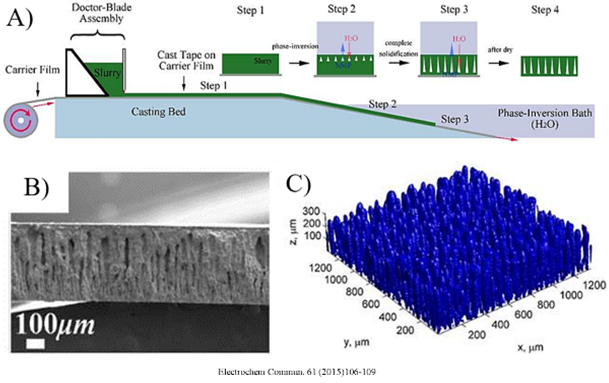
The University of South Carolina will develop and demonstrate an advanced solid-oxide fuel cell technology to cost-effectively and reliably generate electricity directly from hydrocarbon fuels (e.g., natural gas) for distributed and central generation applications. The transformational technology will be built on a planar, porous metal-supported SOFC (MS-SOFC) with its unique thin-film structures intimately supported on a metal substrate. An open channel porous metal support with hierarchically graded porosity will be fabricated using a low-cost, scalable phase-inversion tape casting method. The support will undergo systematic characterization tests to evaluate microstructure features, permeability, and mechanical strength. Cathode, thin-film electrolyte, and anode will be subsequently deposited on the porous metal substrate using an atmospheric plasma spray technique. Novel anode materials will be implemented for direct oxidation of hydrocarbon fuels. Cell fabrication protocols will be developed for manufacturing the proposed MS-SOFCs and then iteratively refined. Characterization tests assisted with SEM/XRD/line-scan to investigate phase formation and possible delamination for deposited bulk layers and the interfaces will be performed. Conceptual validation will be initially conducted on single cells to ensure cell material compositions and APS parameters. The development efforts will be transitioned to large footprint cell fabrication and evaluation once satisfactory results are achieved.
Principal Investigator
Fanglin (Frank) Chen
chenfa@cec.sc.edu
Project Benefits
The SOFC Program is committed to developing efficient, low-cost electricity from natural gas or coal with carbon capture capabilities for distributed generation (DG) and central power generation applications; maintaining cell development and core technology research to increase the reliability, robustness, and durability of cell, stack, and system technology; and providing the technology base to permit cost-competitive DG applications and utility-scale systems with carbon capture capabilities.
Website
University of South Carolina
https://www.sc.edu/