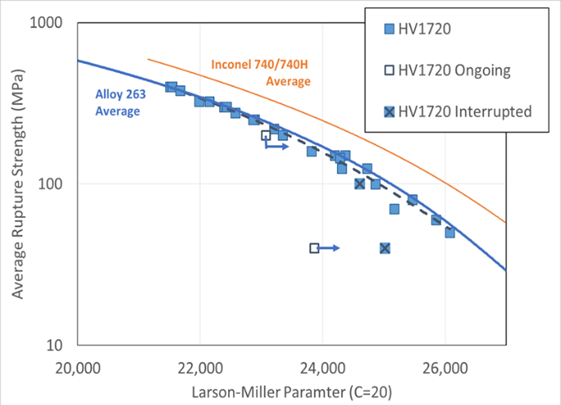
The project will develop a physically based creep model for Nimonic 263 that synthesizes known creep behavior based on gamma prime strengthening with a new understanding of the effects of eta phase on creep performance at long service times in fossil energy power plants. The project will (1) develop heat treatments for commercial Nimonic 263 to obtain a mixture of both eta and γ′ phases prior to creep testing, with the γ′ distribution being as close to commercial Nimonic 263 as possible, (2) conduct creep tests on these materials at the Electric Power Research Institute (EPRI) (3) fully characterize microstructures and deformation mechanisms during creep for all three alloys (standard Nimonic 263, Nimonic 263 heat‐treated to contain eta + γ′, and the Michigan Tech modified Nimonic 263 alloy that contains only eta.), and use the knowledge gained in (2) and (3) to develop and validate a physically‐based creep model that synthesizes known gamma prime creep behavior with a new understanding of the effects of eta phase on creep performance.
Principal Investigator
Walter Milligan
milligan@mtu.edu
Project Benefits
The results obtained in this project will enhance life prediction, component design, and alloy selection for advanced fossil-energy power plants.
Website
Michigan Technological University
http://www.mtu.edu/