Business

Business
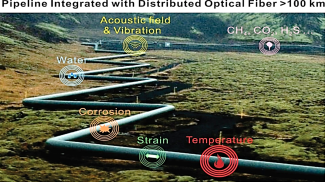
NETL optical fiber sensor technology enhances oil and gas pipeline safety.
New technology developed by NETL researchers provides a revolutionary approach to pinpoint early signs of corrosion in natural gas pipelines before catastrophic failures can occur, significantly enhancing the safety, reliability, and resilience of crucial energy infrastructure.
“Safety issues posed by pipeline corrosion are huge,” said NETL’s Ruishu Wright, co-inventor of the novel, recently patented optical fiber-based sensor system that enables real-time, spatially resolved corrosion monitoring in inaccessible areas of gas pipelines.
According to the U.S. Department of Transportation’s Pipeline and Hazardous Materials Safety Administration, corrosion has caused approximately 25% of all natural gas transmission and gathering pipeline explosions, leaks, and other incidents over the last 30 years. Plus, the department warns, many of the nation’s pipelines are 60 years old, making them susceptible to corrosion and leaks.
“Our technology provides a solution to address those challenges and to save lives, reduce property damages, and prevent the loss of valuable energy resources,” Wright said.
At the heart of the technology is a multiparameter optical fiber sensor. Unlike conventional sensors that detect only one variable, the NETL system can monitor direct corrosion, humidity, and water presence simultaneously along the entire length of the pipeline, offering both direct diagnosis and predictive insights and allowing operators to intervene before significant corrosion occurs.
NETL developed a distributed optical fiber interrogator (a device that reads data from the fiber optic sensor) that serves as both the laser source and the detector, injecting light into the core of the optical fiber and collecting backscattered light along the fiber to achieve spatially distributed sensing. The measured light amplitude, phase, and frequency shift are used to calculate corrosion-caused light intensity changes and water-induced strain changes.
“This patented technology can pinpoint the precise location of potential or developing corrosion with unprecedented accuracy,” Wright said.
Surface acoustic wave (SAW) sensors have the advantages of small size, passive, wireless capability, and low cost. This patent includes a multi-element SAW sensor array used for simultaneous corrosion and humidity monitoring with one single device.
Pipeline operators currently rely on corrosion coupons, small strips of metal inserted in pipelines and spaced out at intervals to monitor internal corrosion. However, coupons can easily miss localized corrosion elsewhere.
In-line inspection tools or smart pipeline inspection gauges scan pipeline walls using ultrasonic, magnetic, or electromagnetic sensors. However, these inspections are typically performed every five to seven years, cost hundreds of thousands of dollars per run, and require highly skilled engineers to process and interpret complex datasets.
“Our technology directly addresses these limitations and moves beyond the paradigm of current pipeline inspection,” Wright said.
One severe form of external pipeline corrosion, called corrosion under insulation (CUI), develops when moisture infiltrates the thermal insulation of a pipeline and remains trapped, creating a hidden, highly corrosive environment where corrosion can occur 20 times faster than on uninsulated systems.
“Beyond internal corrosion monitoring, optical fiber sensors can also be installed externally, under pipeline insulation, to detect external corrosion such as CUI and prevent water ingress into protective coatings such as epoxy paint,” Wright said.
Other developers of the issued U.S. patent “Distributed Multi-parameter Sensors for Simultaneous Monitoring of Corrosion and Humidity: Optical Fiber Sensors and Surface Acoustic Wave Sensors” were NETL’s Nathan Diemler, Nageswara Lalam, and former NETL researchers Jagannath Devkota and Paul Ohodnicki.
NETL is a U.S. Department of Energy (DOE) national laboratory dedicated to innovating and accelerating the nation’s energy solutions in hydrocarbons, geothermal energy, and critical minerals production. The Lab further strengthens its impact by engaging with industry, academia, and other stakeholders through four strategically located Centers of Excellence: Coal, Critical Minerals & Advanced Alloys, Oil & Gas, and Geothermal. With research sites in Albany, Oregon; Morgantown, West Virginia; and Pittsburgh, Pennsylvania, NETL operates as one laboratory to create advanced energy technologies that support DOE’s mission and enable affordable, reliable, and secure energy to fuel human prosperity.