Business

Business
A U.S. patent (US10974969) was issued on April 13, 2021, and expires on September 11, 2038.
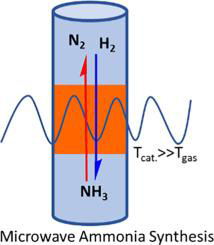
Producing ammonia at smaller, distributed scales requires reaction pathways that are more responsive and energy-efficient than the high-temperature, high-pressure Haber–Bosch process. Researchers at the U.S. Department of Energy’s National Energy Technology Laboratory (NETL), Battelle Memorial Institute, Florida State University (FSU) and West Virginia University (WVU) established a heterogeneous catalyst platform that leverages microwave energy to drive ammonia formation under significantly milder conditions. The catalysts consist of Group 7–11 metals, such as ruthenium, dispersed on metal oxide supports and optionally modified with alkali, alkaline earth or lanthanide promoters. Under microwave irradiation, these materials absorb energy volumetrically rather than through external heating, enabling rapid, localized activation of nitrogen and hydrogen at pressures as low as a few torr and up to 20 atm. This internalized heating mechanism enhances catalytic turnover at lower bulk temperatures while maintaining compatibility with modular, intermittently powered systems linked to renewable energy. The approach supports flexible, scalable ammonia synthesis outside of traditional Haber–Bosch infrastructure. This technology is available for licensing and/or further collaborative research from NETL in partnership with Battelle, FSU, and WVU.
Y. Wang, et al. Microwave-enhanced catalytic ammonia synthesis under moderate pressure and temperature. Methods and compositions for microwave catalytic ammonia synthesis. (2021). Catalysis Communications. DOI:https://doi.org/10.1016/j.catcom.2021.106344.
Paul Ohodnicki, Jr., Kevin Byerly, Dinesh Agrawal and Michael Lanagan
Learn more about NETL's Available Technologies.
 Contact