Business

Business
The objectives of this project are to encourage the development of U.S. oil shale and oil sands resources by creating an information website and conducting applied research that would be of general benefit in making oil sands/oil shale a viable energy resource for the United States.
National Energy Technology Laboratory
Morgantown, WV
U.S. oil resources can meet domestic needs throughout the 21st Century, if unconventional resources are developed to supplement conventional resources.
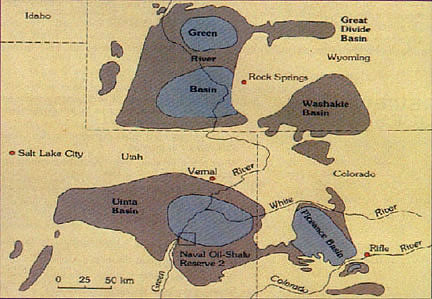
One of those unconventional resources is oil sands. Even the most conservative estimate of domestic oil sands resources indicates that they hold 40 billion barrels of technically recoverable oil available, compared with the 22.4 billion barrels of proven domestic oil reserves. A vast amount of research has been done on oil sands in the U.S.; however, little has been done to use this knowledge.
Domestic oil shale reserves dwarf oil sands resources by two orders of magnitude, but the oil shale hydrocarbons (kerogens) require much more extensive processing than oil sands.
Results
In-house research has provided analysis of unconventional oil resources, including the evaluation of novel technological production methods.
Benefits
NETL resources are used to provide technical and economic assessment on unconventional oil resources for the public.
Summary
Researchers have:
In addition, NETL researchers will work with U.S. and Canadian organizations on applied research that would be of general benefit in making oil sands/oil shale a viable energy resource for the United States. The Alberta Energy Research Institute and Western Research Institute are two organizations that will be consulted for developing potential experimental work. An experimental plan will be developed and submitted to NETL.
(July 2006)
Accomplishments in FY 2006 have included:
Funding This project was selected through the NETL In-House Research Program. Two tasks were cancelled and sent to the NETL University Consortium for funding ($100k).
$685,000
NETL – Sue Mehlhoff (sue.mehlhoff@netl.doe.gov or 918-699-2044)
NETL – Larry Shadle (lawrence.shadle@netl.doe.gov or 304-285-4647)