Business

Business
Research is active on the patent pending technology titled, “Plasmonic-Based pH Sensors in Aqueous Environments.” This invention is available for licensing and/or further collaborative research from the U.S. Department of Energy’s National Energy Technology Laboratory.
Monitoring of chemical composition in subsurface environments is critically important for a range of fossil energy-related applications including unconventional, deep and ultra-deepwater oil and gas resources, as well as the monitoring of carbon dioxide (CO2) migration during geological storage.
Subsurface environments pose an extreme challenge for the development and deployment of sensing technologies due to the combination of high temperature and pressure, the presence of chemically corrosive chemical species, and potential high salinity. The temperatures and pressures present in subsurface environments are beyond the limits of most electrical and electronic components used in sensor applications, which often fail due to the instabilities associated with packaging, wires, and interconnects. For this reason, approaches that replace the need for electrical components and connections at the sensing location can also eliminate a common mode of failure for conventional sensor devices.
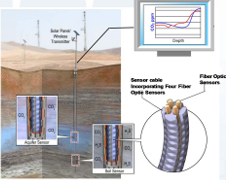
Optical-based sensing methodologies eliminate this concern and can be advantageous from a safety perspective in regards to the presence of potentially flammable gas and chemical species. In particular, sensors that employ fiber-Bragg gratings inscribed into specialty optical fibers, capable of withstanding extreme temperature and pressure conditions, have already been deployed commercially for distributed pressure and temperature sensing. In contrast, optical fiber-based sensors for subsurface chemical sensing applications have not yet been commercially deployed due, in part, to the lack of optical sensor elements with useful, reversible, and rapid responses to particular chemical species of interest.
This invention describes the development and use of fiber optic–based sensing layers composed of metal nanoparticles incorporated into a silica matrix coated on an optical fiber. The new sensing materials have been shown to exhibit strong and reversible optical response to pH variation at high temperatures and pressures under saline conditions. Deployment of sensors using this technology will allow for embedded, real-time, remote pH sensing capabilities in extreme subsurface environments.
Determination of pH in aqueous downhole conditions relevant for unconventional resource recovery
Determination of pH in aqueous geological formations for CO2 storage monitoring
Measurement of pH in industrial chemical processes
Measurement of pH in nuclear power generation applications
Replacement of standard electrode-based pH meters due to the broad pH range, rapid response time, and low hysteresis of response
For more information contact us: