Business

Business
The objective of this research is to develop forward modeling, velocity analysis, and migration methods in anisotropic media. The methodology and algorithms developed by this project will improve the quality and resolution of seismic images that are critical to the economic exploration for hydrocarbons. In addition, this project provides critical understanding of the fundamental physics of wave propagation in anisotropic media, which is necessary for the design of optimal seismic surveys used in hydrocarbons exploration.
Lawrence Berkeley National Laboratory
Berkeley, CA
The effects of velocity anisotropy on reflection seismic imaging have been discussed in the literature for more than a decade. As the petroleum industry has moved into 3-D processing and migration in complex geologies, the adverse effects of unknown velocity anisotropy on depth estimates and image quality have become increasingly important.
Project Results
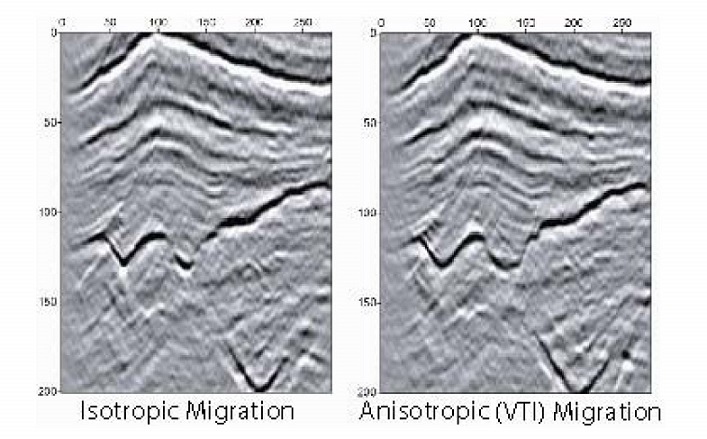
Based on the new forward-modeling codes, researchers have developed reverse-time migration codes for both isotropic and anisotropic media. In addition, a two-step velocity analysis procedure has been developed to estimate anistropic parameters using common midpoint gathers.
This project has resulted in the development of:
Benefits
The model results show that the anisotropy tilt angle has significant effects on amplitude and travel time. Therefore, using a VTI assumption for real TTI media will introduce significant errors in migration and inversion. Acoustic anistropic media might exist in the real world, and the "artifacts" in acoustic anistropic wave equations actually are true shear waves. Numerical and real data examples demonstrate that 3-D Fourier finite-difference depth migration methods developed by this project are better than the generalized screen propagator methods currently in use by industry. Synthetic data have been used to test velocity analysis methods. Tests have demonstrated that using the near-offset traces to estimate the normal moveout velocity (Vnmo) first-followed by estimating the effective anisotropy (n) using large offset traces by fixing (Vnmo)-is faster and more accurate than that seen by estimating Vnmo and n simultaneously.
Project Summary
A significant component of this project has been the development of finite-difference forward-modeling algorithms. The project has developed new celerity-domain Eikonal equation algorithms that are faster and more accurate than any previously developed. The new Eikonal solver models diffractions and head waves with an adaptive, fast-sweeping method, resulting in a more robust and accurate algorithm when compared with existing methods.
A second significant development has been a new finite-difference anisotropic-elastic seismic algorithm using optimal coefficients and a variable-grid finite-difference method to solve the wave equation. The optimal finite-difference coefficients are obtained by a least-squared method in the wavenumber domain. The grid spacing is adapted to the velocity structure using spatial differential operators in a non-uniform grid.
(June 2006)
The project is in its final year. Algorithms are being documented, and codes are being set up for licensing. The project ended at the end of 2005. It was not funded in FY 2006.
$911,000
$850,000 (48% of total)
NETL - Purna Halder (Purna.Halder@netl.doe.gov or 918-699-2083)
LBL - Michael Hoversten (gmhoversten@lbl.gov or 510-486-5085)
Publications
Zhang , L., Hua, B., and Calandra, H., 2005, 3-D Fourier Finite-Difference Anisotropic Depth Migration , SEG 2005, accepted.
Zhang, L., Hua,B., Calandra, H., Rector, J.W., and Hoversten, G.M., 2005, 3-D FFD commom-azimuth depth migration, submitted to Journal of Seismic Exploration.
Zhang, L., Rector, J.W and Hoversten, G. M., 2004, Eikonal Solver in the Celerity Domain, Geophysical Journal International, accepted for publication.
Zhang, L., Rector, J.W., Hoversten, G.M, and Fomel, S., 2004, Split-step complex Pade-Fourier depth migration, Geophysics, in revision.
Zhang, L., Rector, J.W., and Hoversten, G.M., 2004, An Eikonal Solver in Tilted TI media, Geophysics, submitted for publication.
Zhang, L., Rector, J.W., and Hoversten, G.M., 2004, An acoustic wave equation for tilted transversely isotropic media, Geophysical Prospecting, accepted for publication.
Zhang, L., Rector, J.W., and Hoversten, G.M., 2004, Reverse time migration in tilted transversely isotropic media, J. of Seismic Exploration, 13, 173-187.
Grechka, V., Zhang, L., and Rector, J.W, 2004, Shear waves in acoustic anisotropic media, Geophysics, 69, 576-582.
Zhang, L., Rector, J.W., and Hoversten, G.M., 2003, Split-step complex Pade migration, J. of Seismic Exploration, 12, 229-236.
Zhang, L., Rector, J.W., Hoversten, G.M., and Fomel, S., 2004, Split-step complex Pade-Fourier depth migration, 74th Ann. Internat. Mtg., SEG.
Grechka,V., Zhang, L., and Rector, J. W., 2004, Shear waves in acoustic transversely isotropic media, 74th Ann. Internat. Mtg., SEG.
Zhang, L., Rector, J.W., and Hoversten, G.M., 2003, An acoustic wave equation for modeling in tilted TI media, 73rd Ann. Internat. Mtg., SEG (153-156).
Zhang, L., Rector, J.W., and Hoversten, G.M., 2002, Eikonal Solver in the Celerity Domain, 72nd Ann. Internat. Mtg., SEG (2023-2026).
Zhang, L., Rector, J.W., and Hoversten, G.M., 2002, An Eikonal Solver in Tilted TI Media, 72nd Ann. Internat. Mtg., SEG (1955-1958).
Rector, J.W, Zhang, L., and Hoversten, G.M., 2002, Optimized coefficient finite-difference method for wave equation, SEG workshop, 72nd Ann. Internat. Mtg., SEG.