Introduction
Opportunity
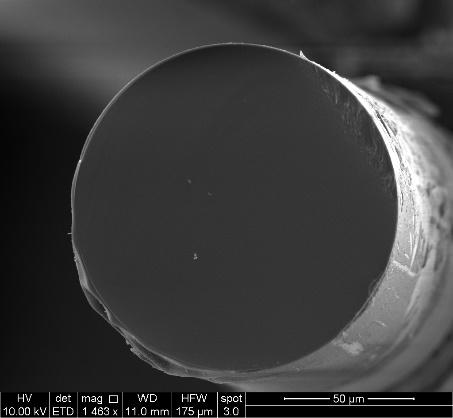
Monitoring pH in wellbores is critical for understanding geochemistry and preventing corrosion, which can help to enhance oil and gas production and improve wellbore integrity. To address this problem, the U.S. Department of Energy’s National Energy Technology Laboratory (NETL) has developed a novel, simple coating synthesis process to enable an optical fiber pH sensor featuring a calcined polyethylenimine (PEI) polymer coating, approximately 1-3 μm thick. This coating, formed by dip-coating and calcination at 400-500°C, creates a pH-sensitive layer that modulates light transmission or backscattering, providing a linear, reversible response across a wide pH range (approximately 3 to 10) at up to 80°C and 1000 psi, with a 1– 2-minute response time. This invention is available for licensing and/or further collaborative research from NETL.
Overview
Problems Addressed
- Costly wellbore monitoring methods that provide only discrete point measurements.
- Lack of durability required for extreme high-pressure, high-temperature (HPHT) conditions.
- Measurement inaccuracies due to environmental changes during sample retrieval from the wellbore to the surface.
Publications
A. Shumski, et al. (2025) Improving stability of an optical fiber pH sensor with a calcined polyethylenimine-coating at high pressures and temperatures. Optical Waveguide and Laser Sensors. https://doi.org/10.1117/12.3053408
Inventors
Alexander Shumski, Ruishu Wright, and Daejin Kim
Download Tech Brief
Benefits
Advantages
- Enhanced Durability and In-Situ Measurements: calcined PEI coating on the optical fiber pH sensor provides
stability and functionality in HPHT environments, enabling subsurface sensing.
- Distributed Sensing Capability: Unlike conventional point sensors, this optical fiber sensor enables spatially
resolved pH monitoring along the entire wellbore length.
- Cost-Effective and Simple Fabrication: simple dip-coating and calcination process offers scalablity of optical fiber
functionalization, for example, via a reel-to-reel coating process.
Applications
Uses
- Subsurface Energy Well Monitoring and Operations: real-time, in-situ, distributed pH sensing in HPHT wellbores to
monitor subsurface pH and well integrity and prevent corrosion.
- Pipeline Integrity and Corrosion Monitoring: continuous, distributed pH monitoring in oil and gas pipelines.
- Deep Water Well Monitoring: durable and long-distance capability for assessing water quality and geochemical
conditions in deep or challenging water wells.
- In-situ Geochemical Monitoring: real-time measurement of pH for harsh subsurface applications including
unconventional wells, enhanced oil and gas recovery, geologic hydrogen, and enhanced geothermal systems.
Learn more about NETL's Available Technologies.

 Contact