Business

Business
A U.S. patent (U.S. 12,286,589) was issued on April 29, 2025, and expires on September 6, 2041.
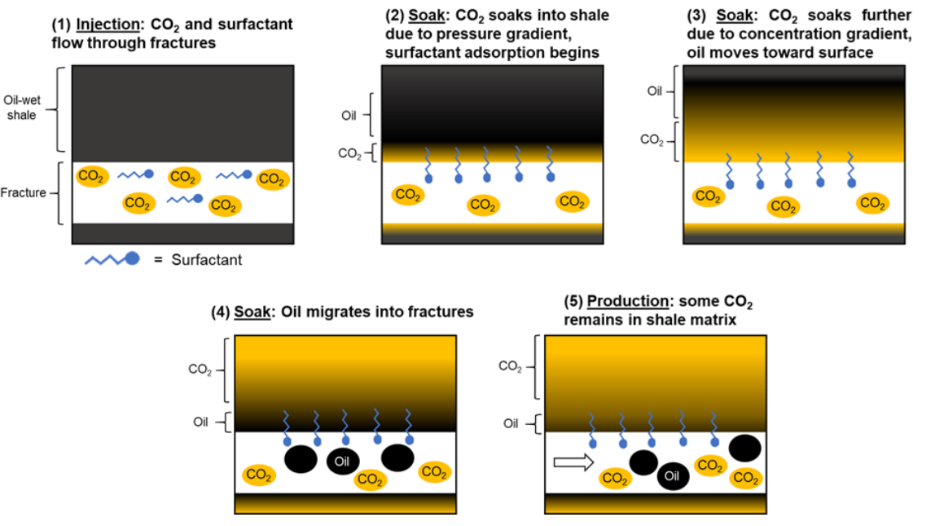
Enhancing hydrocarbon production from low-permeability and unconventional formations often requires modifying how reservoir surfaces interact with injected fluids. Researchers at the U.S. Department of Energy’s National Energy Technology Laboratory (NETL) and the University of Pittsburgh (Pitt.) established a method that uses carbon dioxide (CO2) as a carrier fluid for specialized CO2-soluble compounds that diffuse into and adsorb onto mineral surfaces. These additives include surfactants, amphiphilic polymers, and low-molecular-weight ketones that remain soluble under injection pressures near their cloud points. Once adsorbed, the compounds decrease oil-wettability or increase water wettability or CO2-philicity, shifting the interfacial balance that controls fluid displacement. Because the additives are delivered in CO2 rather than water, they penetrate tight formations more effectively and avoid the viscosity and mass-transfer limitations associated with aqueous surfactant treatments. The method can also incorporate controlled soak periods to maximize diffusion and adsorption before production resumes, supporting improved recovery in formations where conventional foams and water-based enhanced oil recovery (EOR) agents underperform. This technology is available for licensing and/or further collaborative research from NETL in collaboration with Pitt.
R. Enick, et al. Method of oil recovery using compositions of carbon dioxide and compounds to increase carbon dioxide wettability of formations. (2025). United States Patent and Trademark Office. U.S. Patent No.: 12,286,589.
Robert M. Enick, Deepak Tapriyal, Angela Goodman Hanson, Dustin Crandall
Learn more about NETL's Available Technologies.
 Contact