
Business

Business
A U.S. patent (US11067458) was issued on July 20, 2021, and expires on March 16, 2039.
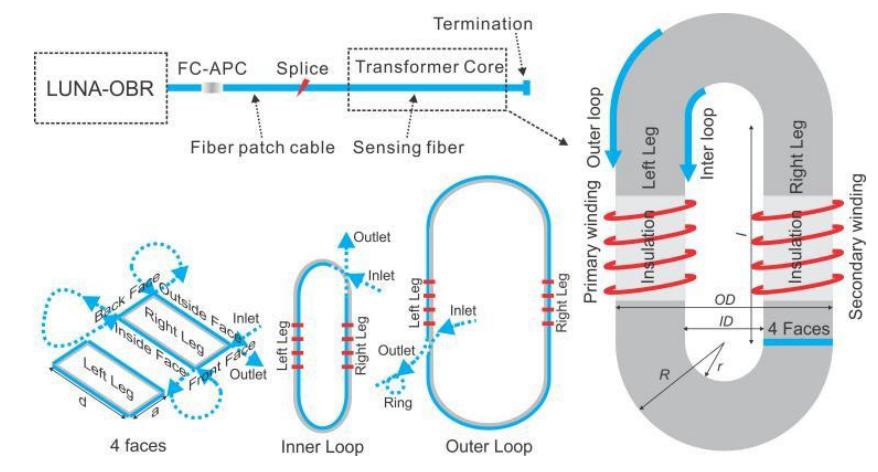
Schematic diagram of the OFDR based sensing system including the
layout of the sensing fiber instrumented on the transformer core.
Diagnosing internal conditions in energized transformers and other power magnetics components requires sensing approaches that can operate in high-voltage, high-temperature, and electromagnetically noisy environments where conventional probes cannot be placed. Engineers at the U.S. Department of Energy’s National Energy Technology Laboratory (NETL) and Carnegie Mellon University (CMU) established an optical frequency domain reflectometry (OFDR) approach that uses standard optical fibers to perform real-time distributed measurements throughout transformer structures. Rayleigh backscattering in the fiber acts as a location-specific optical signature created by nanoscale refractive index variations; when temperature or other stimuli alters the local index, the corresponding spectral shift can be mapped along the entire fiber length. By installing the fiber directly on windings, cores, or within insulation regions, the system provides spatially and temporally resolved temperature profiles that reveal nonuniform heating, emerging faults, and operational behavior inaccessible to point sensors. The same platform can be extended to detect magnetic fields, electric fields, or changes in oil or gas chemistry when paired with thin film functional coatings. This technology is available for licensing and/or further collaborative research from NETL in collaboration with CMU.
Lu, Ping, et al. Real-Time Monitoring of Temperature Rises of Energized Transformer Cores With Distributed Optical Fiber Sensors. (2019). IEEE Transactions on Power Delivery. DOI: https://doi.org/10.1109/TPWRD.2019.2912866
Paul Ohodnicki, Michael McHenry, Alex Leary, Richard Beddingfield and Michael Buric
Learn more about NETL's Available Technologies.
 Contact