
 Share
Share Contact
Modernizing the Oil & Natural Gas Workforce
The Oil & Natural Gas Energy Systems Workforce Hub aligns energy security with modernization. We map workforce readiness to infrastructure upgrades, the digital oilfield, asset integrity, and advanced fuels processing.
RWFI Strategic Priorities
The Regional Workforce Initiative (RWFI) functions not as a training provider, but as a workforce integration platform — delivering analytics, coordination, and tools that enable federal, industry, and educational partners to support the creation of energy jobs.
1. Needs and Gaps Analysis
Linking Standard Occupational Classification (SOC) and the North American Industry Classification System (NAICS) to scale-up phases
2. Readiness Scans
Skill adjacency and labor availability
3. Online Playbook
Transition pathways for energy workers
Systemic Workforce Challenges
Retirement and Experience Gap
Significant portions of technical, engineering, and field operations roles are nearing retirement eligibility. Replacement demand is driven more by retirements than net growth.
Knowledge Transfer Priority
Training Constraints
Enrollment in petroleum training programs remains volatile. Training must expand beyond traditional degrees into applied, employer-aligned models to meet experience-based role requirements.
Applied Training Focus
Skills Modernization Gap
Rapid integration of super intelligence (SI) and automation increases technical requirements. The workforce requires deep upskilling for data-driven decision-making in the midstream and downstream production processes.
Digital Readiness Required
Workforce Needs and Gaps Explorer
This tool connects occupational demand to SOC classifications. It addresses the systemic challenge of mapping skill adjacencies for research-, pilot-, and commercial-scale staffing needs.
Workforce Intelligence Visuals
The visual summaries below highlight supply chain priority roles, transferable workforce pathways, and emerging workforce bottleneck risks.
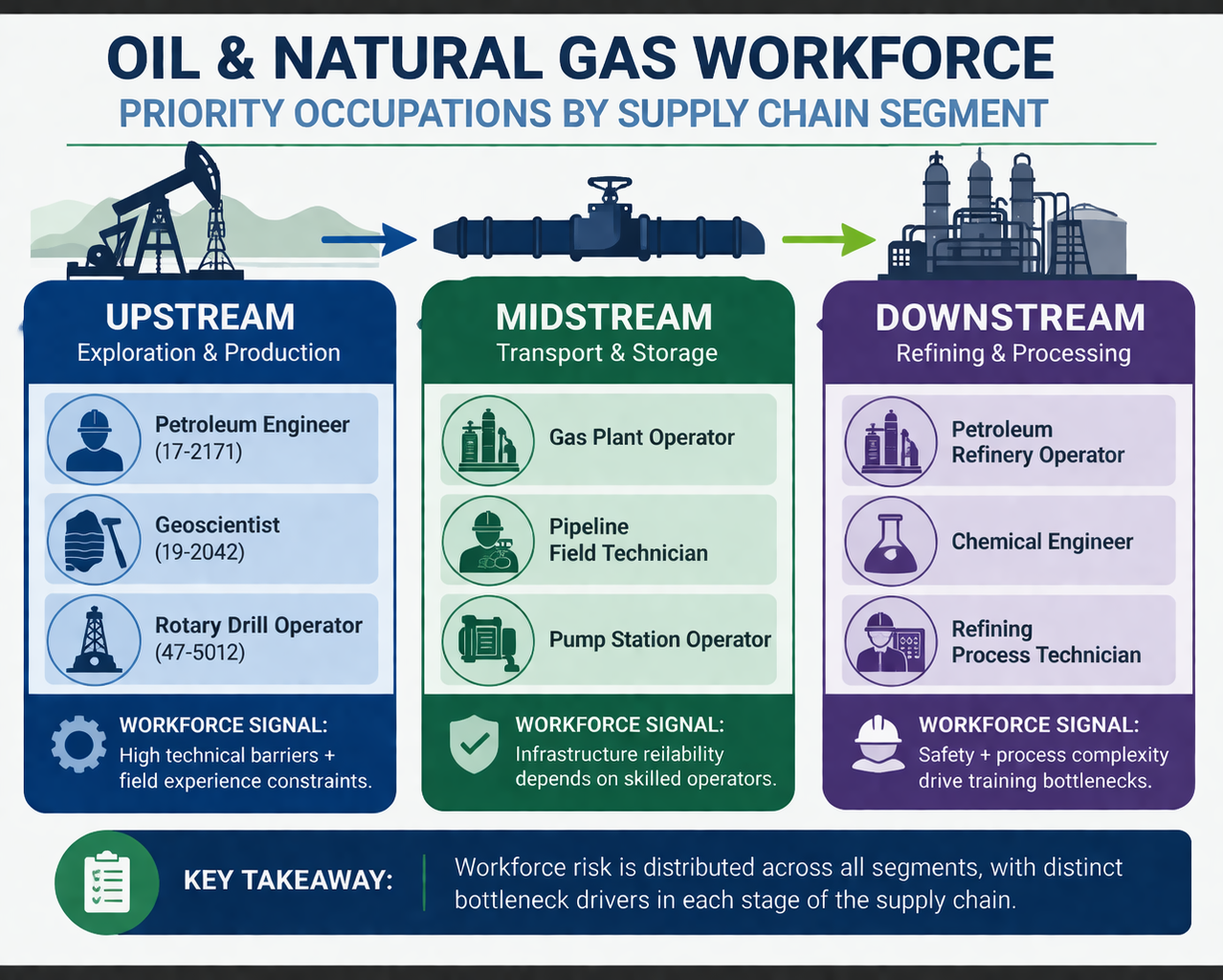
Priority Occupations by Supply Chain Segment
Upstream · Midstream · Downstream
Upstream
Petroleum Engineer (SOC 17-2171)
Geoscientist (SOC 19-2042)
Rotary Drill Operator (SOC 47-5012)
SIGNAL: Significant technical barriers
Midstream
Gas Plant Operator
Pipeline Field Technician
Pump Station Operator
SIGNAL: Infrastructure reliability
Downstream
Petroleum Refinery Operator
Chemical Engineer
Refining Process Technician
SIGNAL: Process complexity
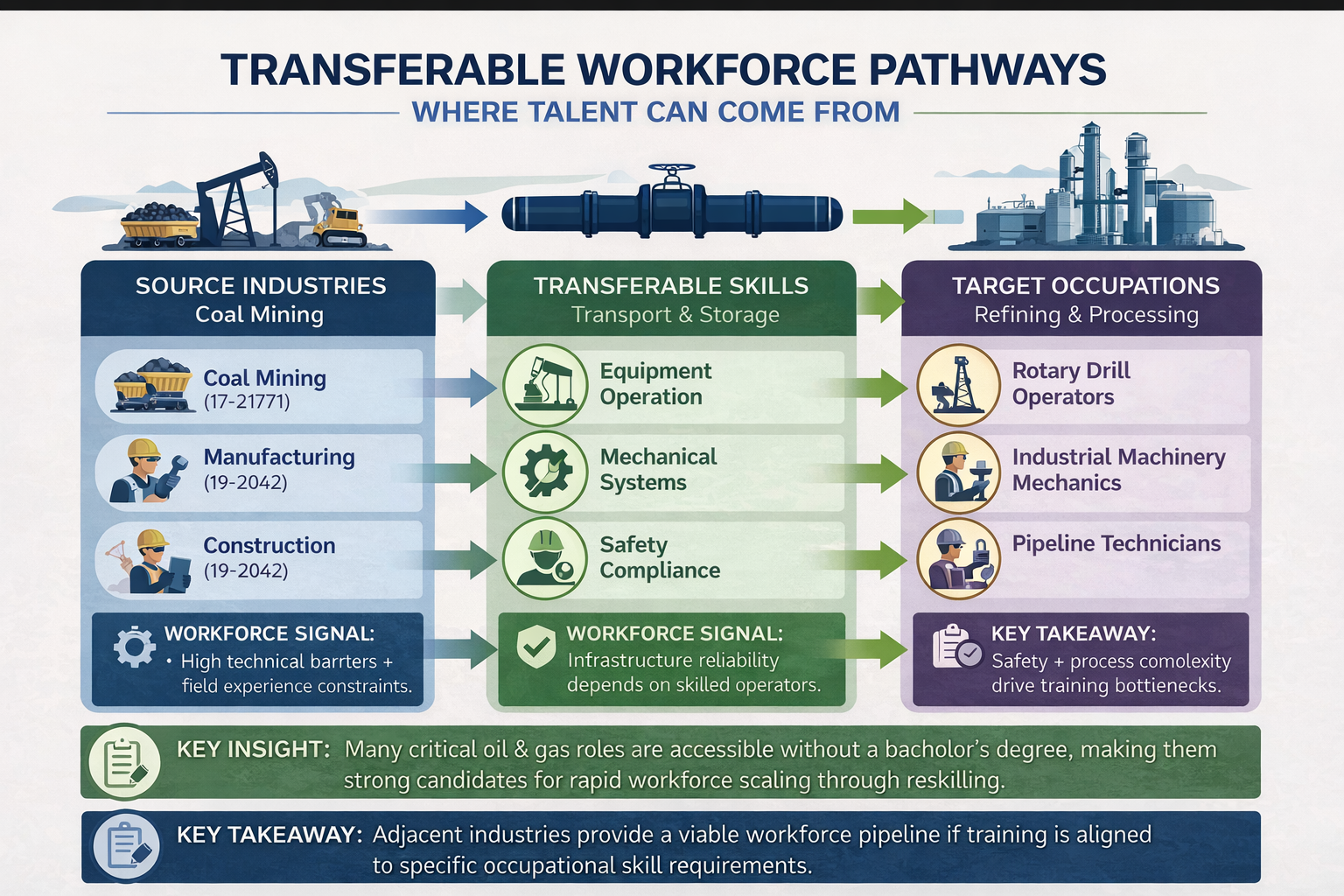
Transferable Workforce Pathways
Cross-Industry Talent Pipeline
Source Industries
Coal Mining · Manufacturing · Construction
Transferable Skills
Equipment Operation · Mechanical Systems · Safety Compliance
Target Occupations
Rotary Drill Ops · Pipeline Techs
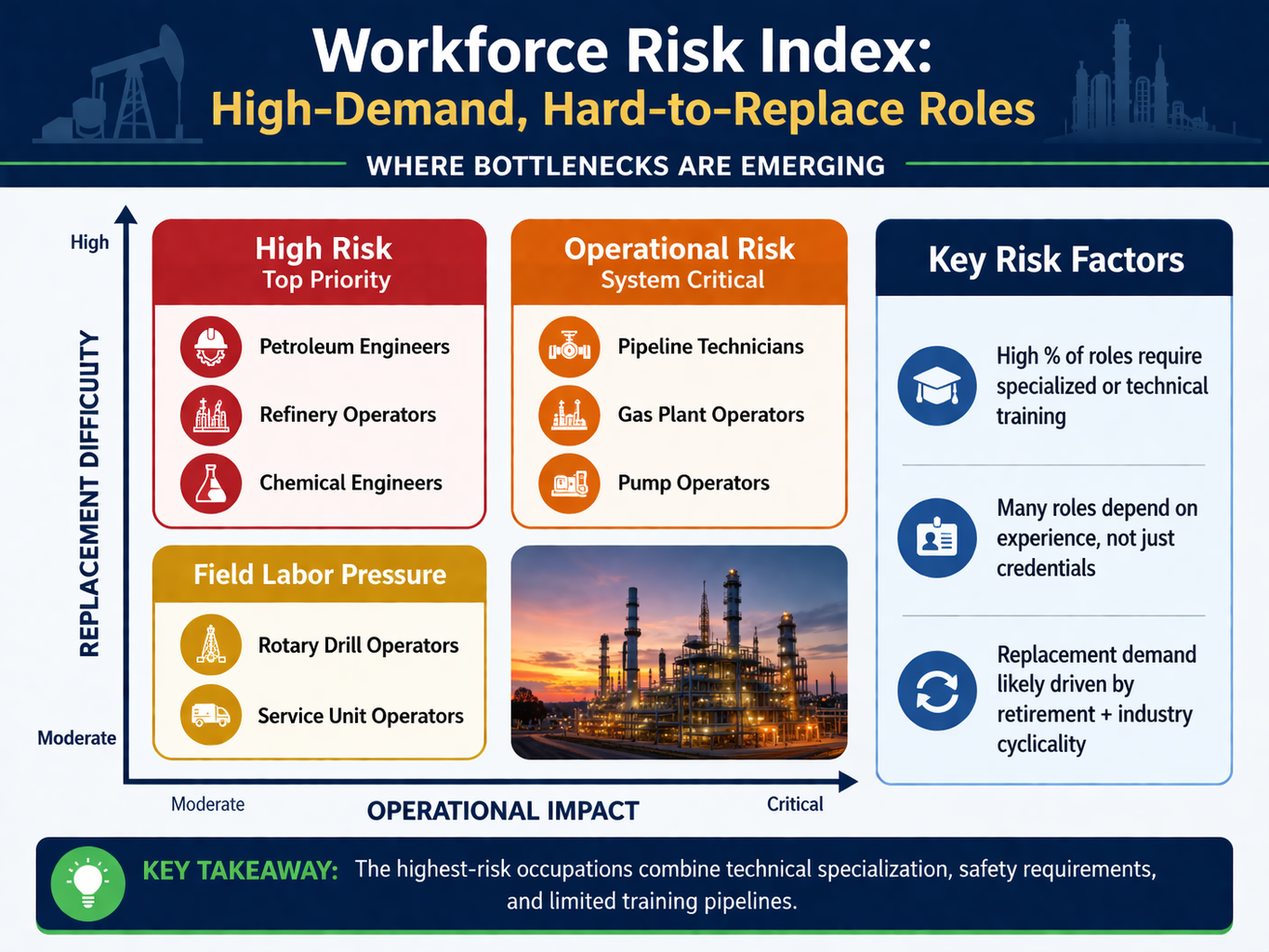
Workforce Risk Index
High-Demand, Hard-to-Replace Roles
High Risk (Top Priority)
Petroleum Engineers · Refinery Operators · Chemical Engineers
Operational Risk (System Critical)
Pipeline Technicians · Gas Plant Operators · Pump Operators
Key Risk Factors
Technical specialization requirements
Dependency on experience vs. credentials
Retirement-driven replacement demand
Strategic Technology Awareness
NETL Research and Development (R&D) Thrusts
Enhanced Oil Recovery (EOR)
EOR improves production from shale via wetting property alterations and nuclear magnetic resonance (NMR) visualization at reservoir conditions.
Recovery Optimization
Subsurface Lab and Imaging
Researchers use pressurized core floods and computerized tomography (CT) scanning imaging to maximize hydrocarbon extraction insights.
Imaging Science
Complex Systems Modeling
SI tools provide fast forecasting and decision support for pore-scale to reservoir reactive transport modeling.
Forecasting & SI
Water Management Hub
Membrane technology and DNA metadata dashboards optimize brine reuse and critical mineral recovery.
Resource Recovery
Infrastructure Resiliency
Optical fiber and wireless sensors monitor pipelines and wellbores in harsh subsurface environments.
Instrument and Control Engineering
Industrial Combustion Technology
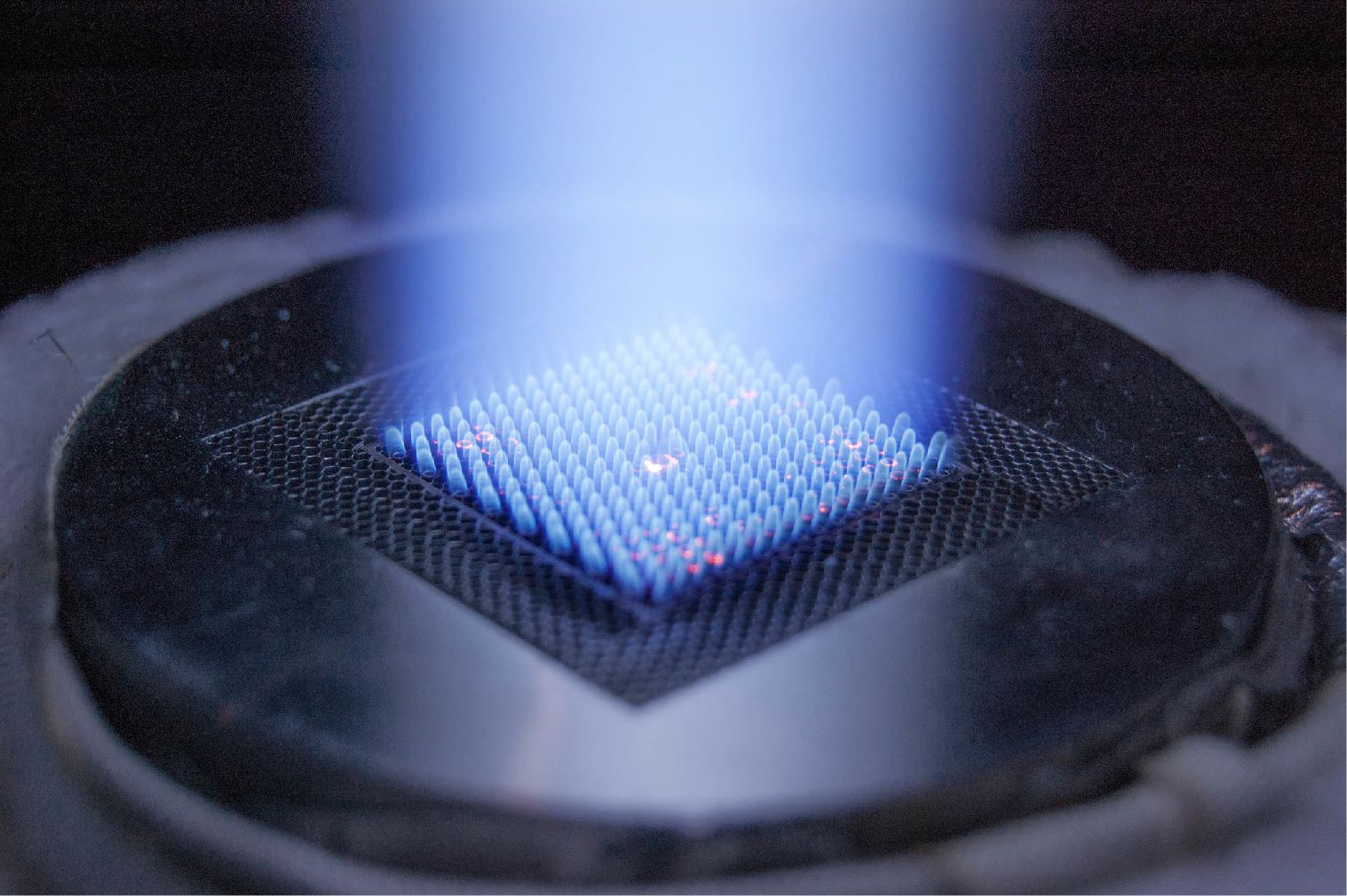
Fuel-flexible combustion systems and rotating donation engines boost industrial efficiency and lower baseload costs. NETL is developing such technologies as part of the Burner Laboratories to Advance fuel utiliZation for thermal Energy (BLAZE) Center.
Advanced Power
Strategic Priorities
NETL's RWFI is advancing workforce capacity across exploration, extraction, midstream transportation, refining, petrochemicals, and downstream manufacturing to support U.S. energy security and system reliability.
1. Comprehensive Workforce Analytics
Developing a quantitative Workforce Needs and Gaps Analysis is crucial to evaluating workforce transferability from adjacent sectors (coal, construction, manufacturing, power generation) into upstream, midstream, refining, and petrochemical operations across the oil and natural gas value chain.
2. Workforce Readiness
Implementing regionally focused Workforce Readiness Scans will begin in key basins (Appalachia, Permian, Gulf Coast), and expand nationally, examining skill adjacency, infrastructure constraints, and workforce scaling potential under multiple production and demand scenarios.
3. Strategic Workforce Integration
Aligning workforce analysis with federal energy planning, permitting and infrastructure priorities, and industry investment decisions will ensure workforce considerations are embedded in project development and energy deployment strategies.
4. Industry and Education Alignment
Steps will be taken to catalyze coordination among operators, midstream companies, refiners, petrochemical manufacturers, unions, universities, and community colleges to align credentialing pathways with evolving technologies, safety standards, and operational needs across the sector.
5. Digital Infrastructure
Expanding the Workforce Hub and online Playbook will deliver interactive dashboards, occupation pathways, regional readiness indicators, and workforce transition tools tailored to oil and natural gas occupations and supply chain segments.
Strategic Resources
DOE Office of Strategic Resources
Access policy frameworks, resource assessments, and federal strategic planning for critical energy materials and domestic supply chains.
NETL Oil and Gas Center of Excellence
Explore research thrusts, technical facilities, and industry collaborations focused on enhancing domestic production and infrastructure integrity.